
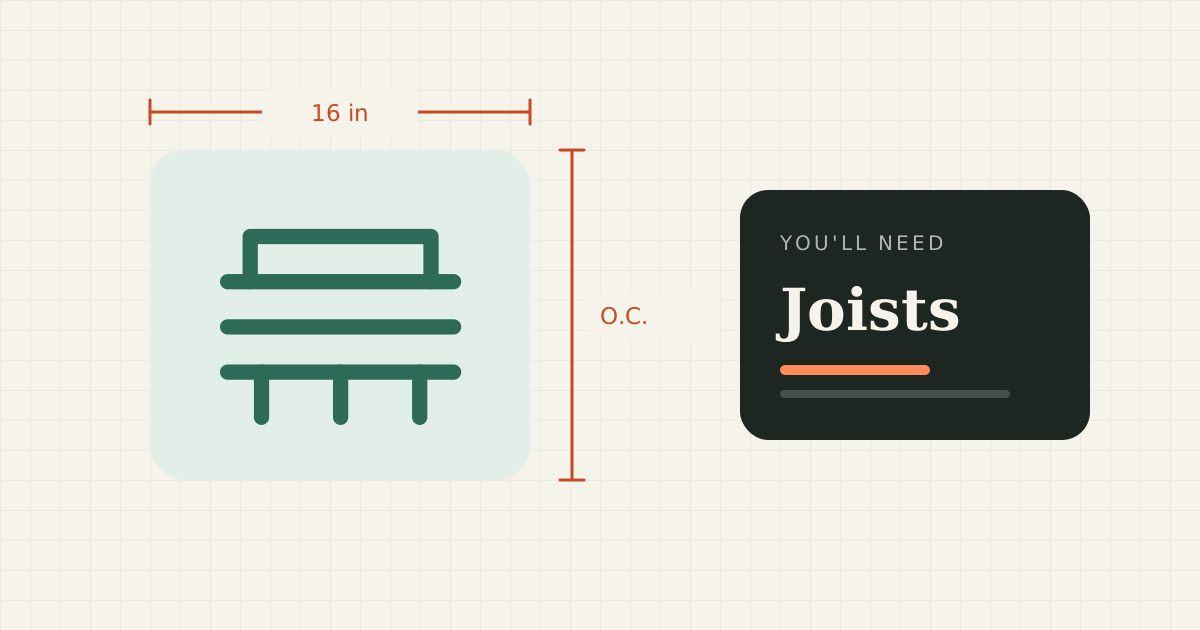
Short answer: most decks use joists 16 inches on center. Composite decking, diagonal patterns and stair treads usually need 12 inches. Wider 24-inch spacing only works with decking that is rated for it.
"On center" (O.C.) means measured from the middle of one joist to the middle of the next. It's the number your decking manufacturer and building inspector will ask about.
Why joist spacing matters
Joists hold up the deck boards. Space them too far apart and the boards bounce underfoot, sag between supports and can crack over time. Space them closer and the deck feels solid, but you pay for more lumber and more labor.
So the right spacing depends mostly on what you're putting on top.
Spacing by decking type
| Decking | Typical joist spacing |
|---|---|
| Pressure-treated or cedar boards, straight layout | 16 in O.C. |
| Composite boards, straight layout | 16 in O.C. (check the brand) |
| Any decking laid diagonally | 12 in O.C. |
| Stair treads | 12 in O.C. or less |
| Thick 2x6 wood decking | Up to 24 in O.C. in some cases |
Trex, one of the largest composite brands, says joists should generally be no more than 16 inches on center for standard installs, 12 inches when boards run at an angle, and 12 inches or less for stairs. Other brands have their own tables, and following them is usually a condition of the warranty.
Diagonal and patterned decks
When boards cross the joists at 45 degrees, each board spans a longer distance between supports. A 16-inch joist layout becomes a span of about 22.6 inches along a diagonal board. That's why diagonal decks drop to 12-inch spacing. Herringbone and picture-frame borders often need extra blocking too.
Joist size is a separate question
Spacing tells you how far apart joists sit. Joist size, like 2x8 or 2x10, depends on how far each joist spans between beams, the wood species and grade, and the load the deck has to carry. Closer spacing lets a given size span a little farther.
For sizing, builders in the U.S. commonly use the American Wood Council's DCA 6, a prescriptive guide for residential wood decks with span tables for 12, 16 and 24 inch spacing. Many local building departments accept it, and most attached decks need a permit, so check with yours before you buy lumber.
Counting joists for your deck
The math is simple: deck length in inches divided by the spacing, plus one for the end.
- A 16-foot deck at 16 inches O.C.: 192 ÷ 16 = 12, plus 1 = 13 joists
- The same deck at 12 inches O.C.: 192 ÷ 12 = 16, plus 1 = 17 joists
Rim joists at each end are extra. Our deck board calculator counts joists, boards and screws together.
Quick checklist before you build
- Read your decking's installation guide and note its maximum span.
- Decide on straight or diagonal boards before you frame.
- Size joists from a span table, not a guess.
- Add blocking where boards butt together, so each end lands on solid wood.
- Confirm permit and inspection requirements with your town.
Sources
- Trex: How to install deck joists
- JLC: Highlights from the American Wood Council's DCA 6
- American Wood Council: DCA 6 updates and errata
Spotted a mistake? Email [email protected] and we'll check it.